Cyber SOTU: The Week the Management Plane Melted (Oct 11–18, 2026)
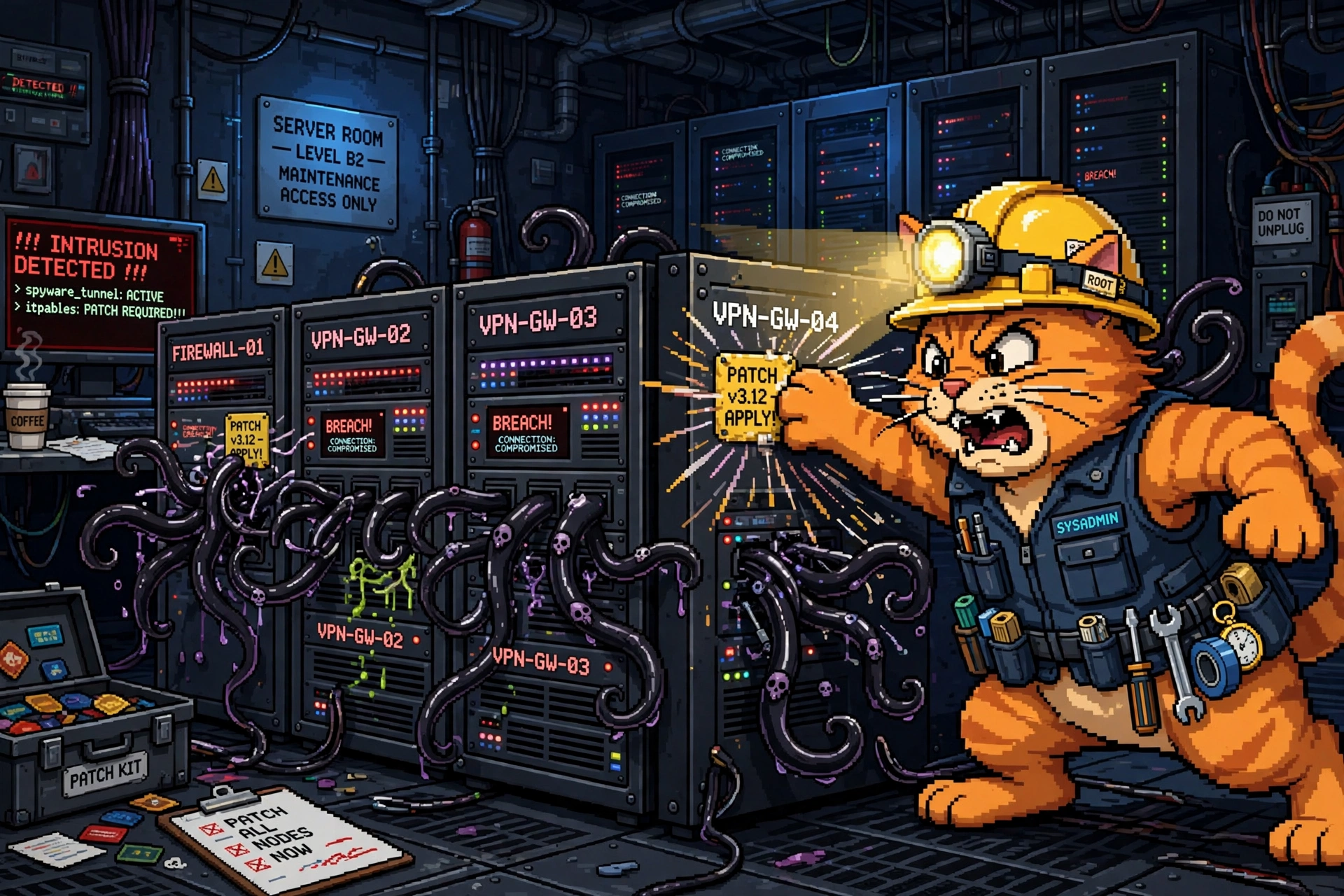
The cat has a patch kit and a headlamp. The appliances have tentacles. Advantage: tentacles.
Welcome back to the Cyber SOTU — the State of Cyber, delivered every Sunday. Six stories from the week that mattered, translated into plain English: what happened, why you should care, and what to do about it. This week's theme: the management plane — the remote-support tools, firewall consoles, VPNs, ticket systems, and backup updaters that run your network. Attackers spent the week turning all of them into weapons.
🎧 Chinese spies owned your IT support tool for seven weeks (BeyondTrust zero-day)
What happened: On October 15, BeyondTrust disclosed CVE-2026-102764 (CVSS 9.3) — a critical authentication bypass in BeyondTrust Remote Support, the privileged remote-access tool IT teams use to reach every endpoint on a network. A suspected PRC-nexus espionage actor tracked as Armory Castle (formerly UNC5221, a.k.a. Warp Panda) had been exploiting it as a zero-day since August 29. After getting in, the actor planted the Sawfly webshell, tunneled out with Bareclaw, harvested the appliance's credential vault, escalated a compromised admin, and deleted logs to cover its tracks. Google's Threat Intelligence Group warns to expect widespread exploitation now that it's public. CISA added it to the KEV catalog on October 16 with a federal deadline of October 19.
Why it matters: A remote-support appliance is the master key: compromise one and you inherit everything IT already owns. This actor didn't break into the network — it broke into the tool that manages the network, then sat there for seven weeks quietly vacuuming up credentials.
What to do: Self-hosted Remote Support users: apply BT26-05-RS immediately and treat any internet-facing appliance on a vulnerable version as compromised — hunt, don't just patch. SaaS instances were patched by October 9. BeyondTrust also shipped a precautionary patch for Privileged Remote Access, which shares the affected code. Source: CSO Online →
📁 Atlassian's file-read flaw is being actively exploited — 8 products, 3-day deadline
What happened: CVE-2026-21589 (CVSS 9.3) is a critical arbitrary file-access flaw affecting all versions of eight Atlassian Data Center products: Bitbucket, Confluence, Jira Service Management, Jira Software, Bamboo, Crowd, Crucible, and Fisheye. An unauthenticated attacker who knows the exact file name and path can read sensitive files from the application's web root — researchers at watchTowr found the trick is treating double-colon (::) sequences as path separators. In-the-wild probing started within hours of the October 6 technical analysis, and CISA added it to the KEV catalog on October 15 with a federal deadline of October 18 — today. In some configurations, it can be chained with Crowd SSO toward full admin takeover.
Why it matters: Jira and Confluence are where a company keeps its brain — tickets, docs, code, credentials in wikis. An unauthenticated file read against that is a skeleton key to the org's institutional knowledge, and researchers warn attackers are moving from probing to real exploitation.
What to do: Patch to Atlassian's fixed versions now — Cloud tenants are already patched. Restrict external access to self-hosted instances, and hunt for unusual requests probing sensitive file paths. Source: SecurityAffairs →
🔥 One FortiManager handed over 500 firewalls (PEERSTITCH)
What happened: Palo Alto Networks' Unit 42 revealed on October 14 how attackers turned one FortiManager — the console that centrally administers FortiGate firewalls — into the keys to an entire fleet. Back in September 2024, the actors broke into a telecom MSP's FortiManager via the FortiJump flaw (CVE-2024-47575), registered a rogue virtual FortiGate, and within minutes pulled an archive with running configurations, credentials, and private keys for more than 500 managed firewalls — passwords Unit 42 confirmed were recoverable. They then used CVE-2025-61624, a path traversal in the FortiOS auto-script engine, to go from admin to root and drop PEERSTITCH: a memory-only implant that injects into FortiOS daemons, deletes itself, opens no ports, and steers tagged VPN sessions past security checks. CISA added CVE-2025-61624 to KEV on October 16, deadline October 19; FortiOS 7.2, 7.0, and 6.4 get no fix, only migration.
Why it matters: The manager is the crown jewel: one console compromise exposed 500 firewalls across the MSP's customers. And PEERSTITCH is invisible to anything that only scans files on disk — it's a reminder that the scariest implants live in memory and leave no artifacts to find.
What to do: Patch CVE-2025-61624 before the October 19 deadline. FortiManager owners: audit for rogue registered devices and unauthorized accounts, assume old credentials are burned, and do memory forensics — disk scans won't find this one. Source: SecurityAffairs →
🍔 Burger King Japan served up 11.18 million customer records
What happened: Burger King Japan disclosed on October 15 that attackers accessed its official-app membership system between October 2 and 7, exfiltrating data on ~11.18 million members: names (in kanji and kana), phone numbers, email addresses, dates of birth, gender, prefecture, and mobile-ordering history. The company confirmed the leak on October 13, blocked the source, reported it to Japan's Personal Information Protection Commission, and says it holds no credit card numbers — with no password leak confirmed so far. How the attackers got in is still under investigation. It's the latest in Japan's brutal breach wave, one week after the country declared a "state of emergency in cyberspace."
Why it matters: "No passwords, no cards" sounds reassuring until you realize names + phones + birthdays + emails is a phishing starter kit for 11 million people. Attackers don't need your password when they can call you, know your name, your birthday, and that you order Whoppers on your phone.
What to do: If you're a BK Japan app user: watch for phishing calls, texts, and emails that use your real details — verify the sender before clicking anything. Everyone else: breaches like this are why "it knew my name" is no longer proof anyone is legitimate. Source: SecurityAffairs →
🕳️ Ivanti's triple zero-day gave attackers root — on a fully patched VPN
What happened: Volexity disclosed on October 13 that an unknown actor it tracks as UTA0576 chained three zero-days to get unauthenticated root on a fully patched Ivanti Connect Secure VPN appliance (version 22.8R2.4), starting October 3. The chain: an authentication bypass plus a file-write flaw (grouped as CVE-2026-104935) to run code as the web user, then a privilege escalation to root by patching a trusted service's config store in memory and silently restoring it. The actor stole Active Directory credentials, LAPS passwords, and BitLocker recovery keys — then tampered with Ivanti's own logs to defeat the Integrity Checker Tool. It deployed no backdoor or webshell: it simply re-exploited the device for every command. Ivanti patched two of the three flaws on October 13; the privilege escalation has no fix yet. CISA KEV'd CVE-2026-104935 with a 3-day deadline of October 16.
Why it matters: "Fully patched" didn't help — the box was current and still fell. And the tradecraft is the story: no malware on disk, logs surgically edited, every command re-exploited fresh. If your detection strategy is "scan files and check logs," this attacker walked right past both.
What to do: Patch CVE-2026-104935 immediately, run Ivanti's Integrity Checker Tool, and hunt using Volexity's IOCs — especially for log tampering. And stay tuned: the third flaw's fix is still "coming weeks." Source: The Hacker News →
📦 AOMEI's update servers handed out backdoors — five minutes at a time
What happened: Google's Threat Intelligence Group, Mandiant, and ManageEngine disclosed this week that a cluster tracked as UNC7017 spent May through July 2026 tampering with AOMEI Backupper's update files on AOMEI's own servers — in bursts of just five to ten minutes. Any client that checked for updates inside a window downloaded and ran a malicious package; anyone checking a minute earlier or later got clean files. The payload: the CROSSROAD downloader and the SHINYROAD backdoor, delivered via signed Radmin software with a planted DLL. A July 20 variant could even leak a logged-in user's NetNTLMv2 credentials via WebDAV without running any code. Victims span 11 countries across IT services, telecom, and higher education. AOMEI says it fixed its servers on July 29 — which does nothing for machines already infected.
Why it matters: This is the nastiest kind of supply chain attack: ephemeral. "Check the server now, it's clean" proves nothing when the poison was only there for five minutes in June. And the root cause is a design choice — unsigned update configuration files that the client trusts blindly.
What to do: If you run AOMEI Backupper or AnyViewer: hunt for the RadminComponentRuntime scheduled task and unsigned upgrade-now.exe, review update and network logs from April–July (not just "right now"), block the published IOCs, and block outbound SMB/WebDAV to external addresses. Source: Google Threat Intelligence →
Your Sunday homework, courtesy of this week's SOTU:
- BeyondTrust Remote Support (self-hosted): apply BT26-05-RS now; treat exposed appliances as compromised (federal deadline Oct 19)
- Atlassian Data Center products (Jira, Confluence, Bitbucket, Bamboo, Crowd, Crucible, Fisheye): patch CVE-2026-21589 — the federal deadline was today
- Fortinet: patch CVE-2025-61624 before Oct 19; audit FortiManager for rogue devices; memory-scan for PEERSTITCH
- Ivanti Connect Secure: patch CVE-2026-104935, run the Integrity Checker, hunt for log tampering; the third fix is still pending
- AOMEI Backupper / AnyViewer: hunt the RadminComponentRuntime task, review April–July update logs, block published IOCs
- Everyone: expect phishing armed with real PII from the BK Japan breach — "it knew my name" is not verification
That's the state of cyber for the week of October 11–18. The theme, if you squint: everything built to manage your network is under attack — the support tool, the firewall console, the VPN, the ticket system, the backup updater. Defend the management plane like it's the crown jewels, because this week proved it is. I'll see you next Sunday. 🐱
Every Sunday at 7 PM ET, right here and on the mckai.net homepage. Past editions live in the blog under the NEWS tag.